QCTiP 2026 Call for Submissions
Talks will be selected based on their scientific excellence, fit to the workshop theme, and overall programme balance. Submissions are expected that report on recent advances in quantum information and computation.
Topics of interest include, but are not limited to:
- Applications of quantum computers
- Architectures for quantum computing
- Quantum algorithms
- Quantum compilation and circuit optimization
- Quantum error correction and fault tolerance
- Digital and analog simulation of quantum systems
- Theory of near-term quantum computing
- Verification of quantum software and hardware
- Error mitigation and benchmarking
All submissions must be made online via the link [HERE].
Talk Submissions Format
A contributed talk submission must include a full technical manuscript containing all technical details of the work. While manuscripts available on online repositories such as arXiv are acceptable, a PDF copy must still be uploaded. Only original research papers will be considered; survey papers, PhD theses, and white papers are not eligible.
Submissions must include the following two PDFs
- a self-contained 3-page (excluding bibliography) extended abstract
- a technical manuscript that should ideally be available on the arXiv
The program committee will base their decisions largely on the extended abstract, but may review the full paper at their discretion. If your submission comprises multiple papers, please combine them into a single PDF file. Submissions must be complete and include sufficient information to allow verification of results.
Presenters are expected to attend the workshop in person and therefore need to make sure to purchase a ticket before the registration deadline. Submissions not selected for talks may be offered the opportunity to present as posters, unless deemed out of scope by the programme committee.
Poster Only Submission
If you intend to submit a poster-only contribution, please select the poster track during submission. A brief abstract of 1-3 pages is sufficient for poster submissions.
Key Dates
- Talk Submission Opening: 5 January 2026
- Talk Submission Deadline: 11 January 2026
- Poster Submission Deadline: 25 January 2026
- Talk Notification of Acceptance: 20 February 2026
- Poster Notification of Acceptance: 25 February 2026
- Conference Dates: 20-22 April 2026
Programme Committee
Programme Committee Chair
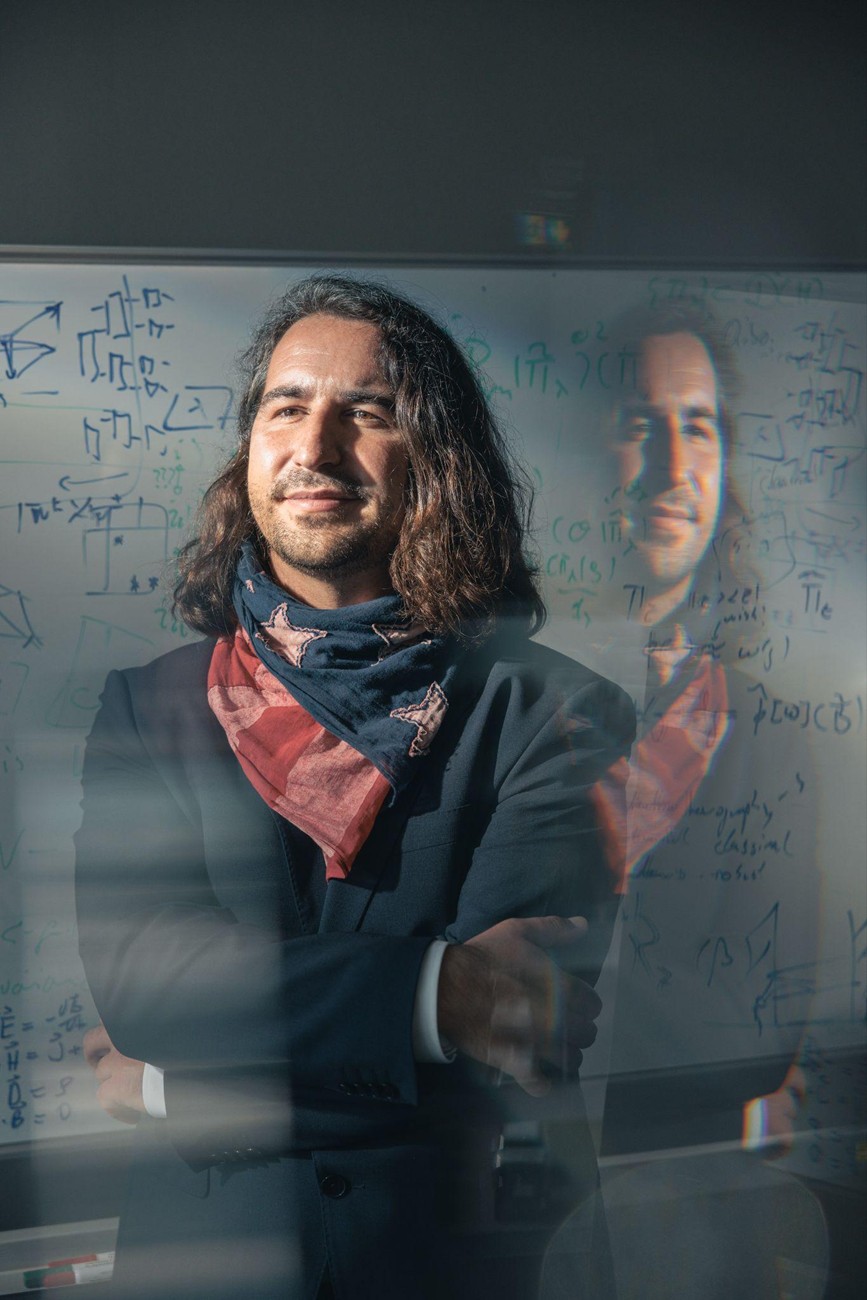
Richard Kueng (Johannes Kepler University Linz, Austria)
Richard Kueng pursues an interdisciplinary research agenda at the interface between computer science (algorithms & computational complexity), physics (quantum information & quantum technologies) and applied math (convex geometry & high dimensional probability theory). Broadly speaking, he aspires to develop efficient and simple solutions for important algorithmic challenges that also come with rigorous performance guarantees. Together with Hsin-Yuan Huang and John Preskill (both at Caltech), Richard Kueng developed the classical shadow formalism – an efficient quantum-to-classical conversion procedure that has made a lasting impact on quantum computing technologies. He is currently a full professor at JKU Linz and head of the department for quantum computing. He is also a member of the board of directors in the Austrian excellence cluster quantA and an elected member of the young Austrian academy of Sciences. In 2023, Richard Kueng received both a Starting Grant from the European Research Council (ERC), as well as the Austrian pendant called FWF START.
Programme Committee Members
- Antonio Anna Mele (FU Berlin)
- Francesco Anna Mele (Scuola Normale Superiore di Pisa)
- Leandro Aolita (Technology Innovation Institute Abu Dhabi)
- Janos Asboth (Budapest University of Technology)
- Lucas Berent (Iceberg Quantum)
- Vjosa Blakaj (University of Copenhagen)
- Paolo Braccia (Los Alamos National Lab)
- Michael Bremner (UTS Sydney)
- Dan Browne (University College London)
- Daniel Cavalcanti (Algorithmiq)
- Ieva Cepaite (Phasecraft)
- Jonathan Conrad (EPFL Lausanne)
- Arjan Cornelissen (Simons Institute)
- Abhinav Deshpande (IBM Reserarch)
- Andrew Doherty (University of Sydney)
- Arkopal Dutt (IBM Quantum)
- Andreas Elben (Paul Scherrer Institute)
- Francisco Escudero Guiterrez (CWI Amsterdam)
- Paul Faehrmann (FU Berlin)
- Philippe Faist (FU Berlin)
- Marco Fanizza (Inria)
- Diego Garcia Martin (Los Alamos National Lab)
- Linnea Grans-Samuelsson (University of Oxford)
- Sander Gribling (Tilburg University)
- Dmitry Grinko (QuSoft Amsterdam)
- Shouzhen Gu (Yale)
- Jonas Haferkamp (Saarland University)
- Robin Harper (University of Sydney)
- Tobias Haug (Technology Innovation Institute Abu Dhabi)
- Jonas Helsen (CWI Amsterdam)
- Nicholas Hunter-Jones (UT Austin)
- Sofiene Jerbi (FU Berlin)
- Yifan Jia (University of Copenhagen)
- Michael Kastoryano (AWS and University of Copenhagen)
- Robbie King (Google Quantum AI and Caltech)
- Johannes Knoerzer (ETH Zuerich)
- Aleks Kubica (Yale)
- Anthony Leverrier (INRIA)
- Yunchao Liu (IBM Research)
- Peter Love (Tufts University)
- Angelo Lucia (Politecnico di Milano)
- Sam McArdle (AWS)
- Alex Meiburg (Perimeter Institute)
- Alex Nietner (FU Berlin)
- Harold Ollivier (Inria)
- Michal Oszmaniec (CTP PAS Warsaw)
- Aadil Oufkir (RWTH Aachen)
- Adrian Perez-Salinas (ETH Zuerich)
- Lirandë Pira (National University of Singapore)
- Alejandro Posas-Kerstjens (Universite de Geneve)
- Sergi Ramos Calderer (National University of Singapore)
- Joschka Roffe (University of Edinburgh)
- Gregory Rosenthal (University of Toronto)
- Mark Steudtner (PsiQuantum)
- Daniel Stilck-Franca (University of Copenhagen)
- David Sutter (IBM Quantum)
- Jordi Tura (Leiden University)
- Albert Werner (University of Copenhagen)
- Mischa Woods (Inria)
- James Wootton (MothQuantum)
- Leonardo Zambrano (ICFO)
- Zoltan Zimboras (Algorithmiq and University of Helsinki)
- Sebastian Zur (IRIF, CNRS)